
SEA2 Network Infrastructure & Architecture Summary
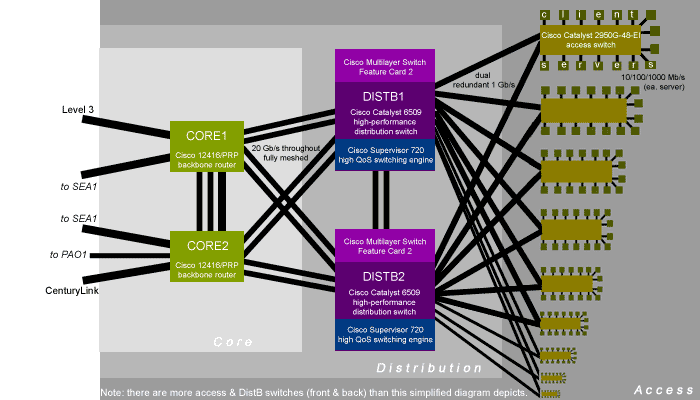
Our SEA2 advanced Data & Network Operations Centre (NOC) in Seattle, Washington is an essential part of our core network. The SEA2 NOC is staffed by highly experienced Systems & Network Administrators 24 hours a day, 365 days a year, and features three (3) parallel N+1 500KVA UPS systems with maximum battery life, a 1.5MW diesel generator, and 100s of tons of AC capacity. The local network is arranged in four logical segments:
Our network does not use any 10Mb/s or 100 Mb/s switches, or any hubs - at all. It is completely 10 Gigabit Ethernet (multiple, redundant 10,000 Mb/s for all network layers) and Gigabit Ethernet (1,000 Mb/s for the individual server access layer) based. Both internal and external network provide multiple, redundant, paths. Each and every piece of the network is fully redundant: there is no single point of failure. The network also includes a number of multi-terabyte tape and RAID-based backup systems. Physical Network Infrastructure Level 3, OnFiber, q.West, ELI, Integra Telecom, SpectrumNet, and Sabey, some of the most financially healthy fibre carriers, provide our local private, redundant, SONET-ring based fibre transport circuits. In addition, Level 3 and ELI/Integra Telecom provide the direct private long-haul fibre routes out of SEA2. The multiple, different carrier, OC-192 SONET rings each consist of two redundant OC-192s traversing two separate paths and having two diverse routes to our facilities, thus providing the ultimate in reliability and performance. Even if both of the lines are cut at any point, the OC-192 ring is still operational, with less than 50 ms (0.05 second) self-healing restoration time. The multiple private SONET rings provide us the ultimate in reliability: no downtime even in the case of a major fibre cut in the area (due to separate paths and multiple fibre transport providers). A number of other fibre carriers are on site, too: ELI, Integra Telecom, OnFiber, q.West, AboveNet, Level 3, and Sabey just to name a few, and more are nearby. Furthermore, we do not only connect within the Seattle metro area. The Seattle portion of our network is fully tied in with our national coast-to-coast IP backbone, and connects to downtown Seattle, WA (SEA1), Palo Alto, CA (PAO1) and McLean, VA (DCA2) directly, and Palo Alto, CA (PAO1), Chicago, IL (CHI1), Ashburn, VA (IAD1), and McLean, VA via our downtown Seattle, WA site (SEA1).
Logical Network Architecture |
|
||||||||||||
|
|||||||||||||
|
Run a traceroute from our SEA2 network. Traffic from SEA2 considers all the outgoing
routes - be it at the same site or at one of the many other sites - weighted for physical distance,
reliability, performance and latency, and picks the most direct, lowest latency route available to the
destination. That is, all the packets take the most direct, fastest, way out and have a full BGP selection
of all the transit providers and peers at all the sites, not just the transit/peering lines present at that
particular site. The network is fully inter-connected and meshed.
For more details on our core network, such as a full backbone connectivity and peering diagram and network maps of our transit Tier 1 backbone connectivity providers, please review details on our core network. All customers and independent tests find our network to be better performing than any single competitor. Our industry-leading SLA guarantees that. 
Further Advantages of Our Network Seattle is one of the best connected high-tech cities in the US (all major networks peer locally in Seattle, and it is under 30ms to California, under 75ms to the East Coast), and has some of the most reliable power anywhere. Furthermore, we are located in a stable and level area (ground level of a well-built single story facility), providing the best resistance to earthquakes, and have multiple diverse-path fibre transport circuits with Level 3, OnFiber, q.West, ELI, Integra Telecom and Sabey. In Seattle we peer both at the SIX (Seattle Internet Exchange) and PAIX Seattle, thus reaching almost all the major networks locally. This is further built upon by our redundant connectivity to multiple Tier 1 providers via separate circuits, terminating at diverse locations in Tukwila (south of Seattle) and Seattle downtown. We are redundantly set-up Internet connectivity wise (multiple backbone connectivity providers), as well as physically. In terms of fiber optics, we have multiple private SONET rings with multiple financially-healthy fibre providers, taking different physical paths. We have built our facilities in the best possible area for Internet connectivity, and then further reinforced it with redundancy in all possible forms and factors. The big 1.5MW generator can keep well over 8000 servers up and running indefinitely. The three (3) N+1 redundant 500KVA UPS systems (with maximum battery life each) ensure that even if one UPS fails, there is no noticeable impact whatsoever. There is currently 300 tons of Air Conditioning within the data centre, with easy ability to nearly double it to 540 tons using the existing dry coolers. The entire data centre has been built out with no expense being spared, and with further future expansion in mind. As it stands now, it is already able to accommodate over 8000 servers. To ensure the best routing of our customers' data, we pay for commercial top-priority transit network capacity to our tier 1 backbone providers and have full burst capacity available at all times on all circuits. Thus we receive the highest level of service, including 99.99% or 100% uptime and no packet-loss guarantees, from all our connectivity providers. 90%+ of traffic from us to end users only passes over one or two backbones on its way to reaching the end destination. In addition, we are committed to under 50% network capacity utilization at all times; we ensure that our network always has double the capacity it needs, even at peak hours. Our network design and operations ensure the very best connectivity, speed, and reliability possible: 100% network uptime, no packet loss, and under 3 ms low latency connection to Tier 1 backbones - guaranteed by our industry-leading SLA. Our SEA2 network & site in summary:
|
|||||||||||||
